TECHNOVA
NOVA SONAR™
NOVA SONAR™
Couldn't load pickup availability
SPECS
IT DOES NOT COME WITH GEL OR BATTERIES DUE TO LOGISTICS PRECAUTION (YOU CAN PURCHASE THE GEL SEPARATELY ON OUR WEBSITE)
Product Description
Certification: CE Certified
Product Name: Ultrasound Transmission Gel
Compatibility: Suitable for Fetal Dopplers and Heart Rate Monitors
Type: Household Health Monitor Accessory
Material: Waterborne Polymer Gel
Chemical Safety: No harmful or high-concern chemicals
Form: Gel
Quantity: 1 unit
Capacity: 100 ml
Size: 100 ml tube
Important Information:
-
This product is offered in two versions: boxed and unboxed . Be sure to select the correct option when purchasing.
-
Three versions are available : standard, enhanced, and Bluetooth. Please carefully check the desired version before ordering.
-
Unboxed products will be securely packaged and suitable for shipping.
-
If you have any issues upon receiving your order, please contact our Customer Service team first . We'll be happy to help and resolve any issues as quickly as possible. Thank you for your trust!
Correct Method of Use:
-
Turn on the device.
-
Apply a little conductive gel to the probe (this can be ultrasound gel or even water-based lubricating gel).
-
Lie on your back, relax, and gently press the probe onto your abdomen.
-
Move the probe slowly to look for the fetal heartbeat.
-
When you hear a regular, loud sound , similar to a gallop or a steady roar, you have located the baby's heart.
-
At this point, hold the probe firmly in that position; the device will automatically calculate the fetal heart rate within a few seconds.
The normal fetal heart rate is usually between 110 and 160 beats per minute .
Tip: It is advisable to start the search from the lower abdomen and slowly move upwards.
Important Note:
Before paying attention to the number on the screen, make sure you are hearing the baby's actual heartbeat correctly.
If a regular, rhythmic sound is not heard, the value displayed by the device will be invalid .


Features of the Fetal Heartbeat Monitor
1. Clear Sound of the Fetal Heartbeat
Equipped with intelligent noise reduction technology and a built-in sound-isolating unit, this device provides clear and distinct hearing of your baby's heart rate. The result is clean, interference-free sound, facilitating accurate detection.
2. Information LCD Screen
It includes a high-visibility digital display that shows multiple parameters, including the fetal heart rate (FHR) in real time, clearly and accurately.
3. High Sensitivity and Medical Safety
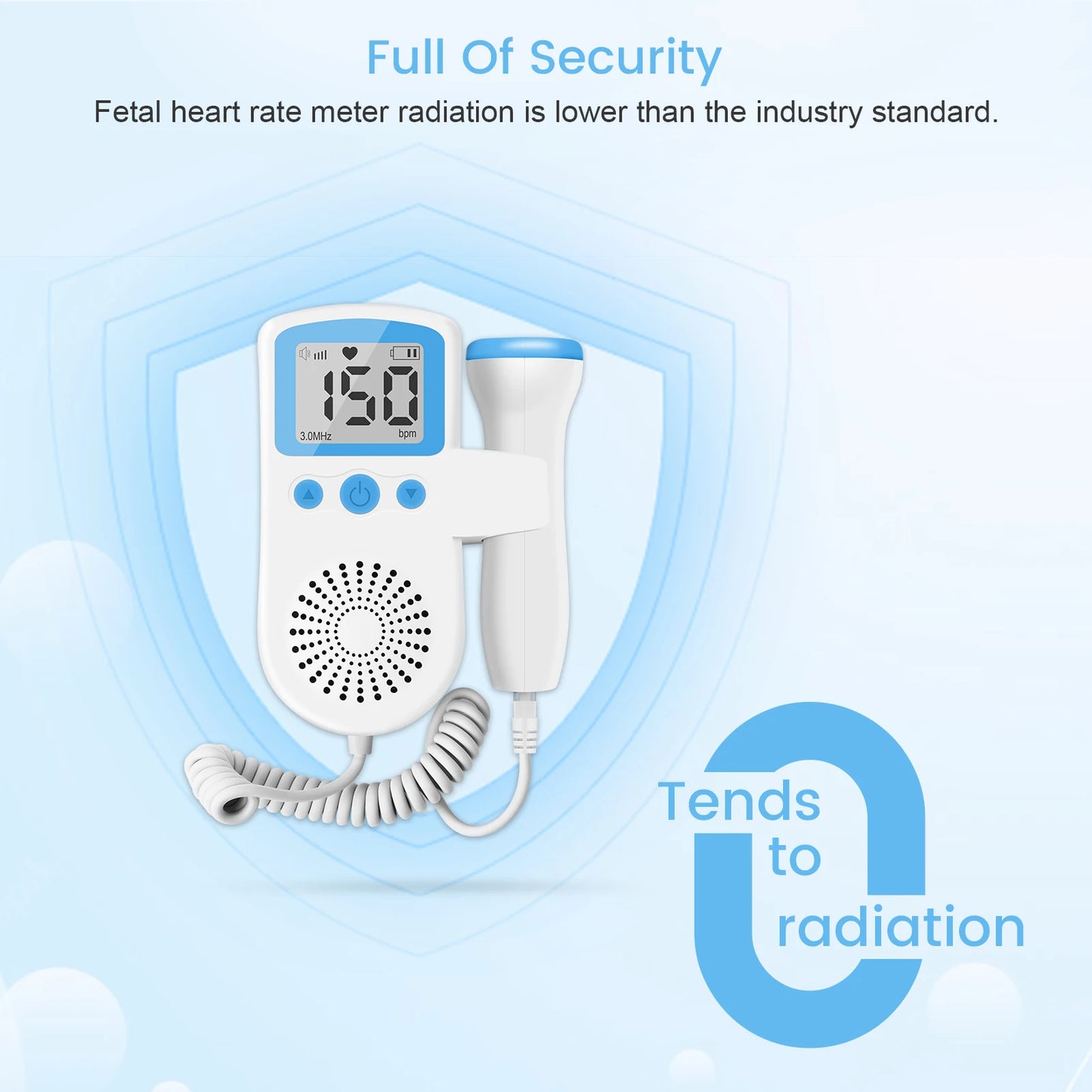
The highly sensitive medical probe is waterproof and radiation-free. It emits low-power ultrasound, making it safe for the fetus. It is IPX1 certified and has a detachable design for easy cleaning and replacement.
4. Compatible with Built-in Speaker
Thanks to its built-in speaker, you can clearly hear your baby's heartbeat without the need for additional headphones.
5. Ideal for Recording and Sharing
Perfect for listening to and recording your baby's heartbeat from week 12. Share this special moment with your partner, family, or friends, whether you're at home or on the go.
6. Lightweight and Portable
Designed to be easily carried with you. Its compact size allows for monitoring at any time of day.
7. Energy Saving
Includes an automatic shut-off function after 60 seconds of non-use, to avoid unnecessary battery consumption.
Technical Specifications
-
Material: ABS plastic
-
Colors: Pink + Blue
-
Screen: 45 mm × 20 mm
-
Recommended gestational age: From week 9
-
Probe operating frequency: 3.0 MHz ± 10%
-
Fetal heart rate range: 50 – 240 BPM
-
Power: 2 AA batteries (not included for air transport reasons)
-
Device size: 6.3 × 3 × 13 cm
-
Probe size: 3.2 × 10.4 cm
-
Probe cable: 1.5 m
When is it best to use the monitor?
For clearer results, it is recommended to use it at these times of the day:
-
In the morning, within the first 30 minutes after waking up
-
Within 60 minutes after lunch
-
During the 30 minutes before sleeping
Fetal Heart Position Reference
-
First trimester (12–24 weeks): Area around the navel, 5 cm down to the left, center and right.
-
Second trimester (24–32 weeks): Midline of the navel and 4 cm below.
-
Third trimester (32–40 weeks): 4 cm in an oblique direction from the navel to the sides.


Frequently Asked Questions and Precautions
What does a fetal heartbeat sound like?
The fetal heart sound is like a "choo-choo-choo", similar to that of a small train or a horse's trot ("da-da-da"), with a very constant and defined rhythm.
Why is it necessary to move the position probe?
Because the fetus is constantly moving inside the uterus, the position of its heart also changes. If the heartbeat is not clearly audible or is very weak, you should gently move the probe until you find the spot where the sound is clearest.
How often can the test be done? Can it affect the baby if it's done too often?
The device's fetal heart rate and other indicators meet national safety standards. You can use it with confidence to monitor fetal heart rate daily. Under normal conditions, it is recommended to measure two to three times a week. Pregnant women of advanced age or with a history of miscarriage can increase the frequency of use if desired.
How do you find the fetal heartbeat correctly?
To locate the heartbeat, move the probe slowly and within a small range (approximately one centimeter) and hold it at each point for two or three seconds. It's important to be patient, as moving the probe too quickly can make it difficult to find the heartbeat. Once you hear the heartbeat, continue moving the probe slowly until you find the position where the sound is loudest and clearest. At that point, the measurement will be most accurate and interference-free.